
How to choose educational training institutions and academic management systems

1. The functions and characteristics of the academic management system
The academic management system is a software that integrates functions such as enrollment, course scheduling, teaching management, student management, and financial management. Different brands and models of educational management systems have differences in functionality, but they generally cover the following major functional modules:
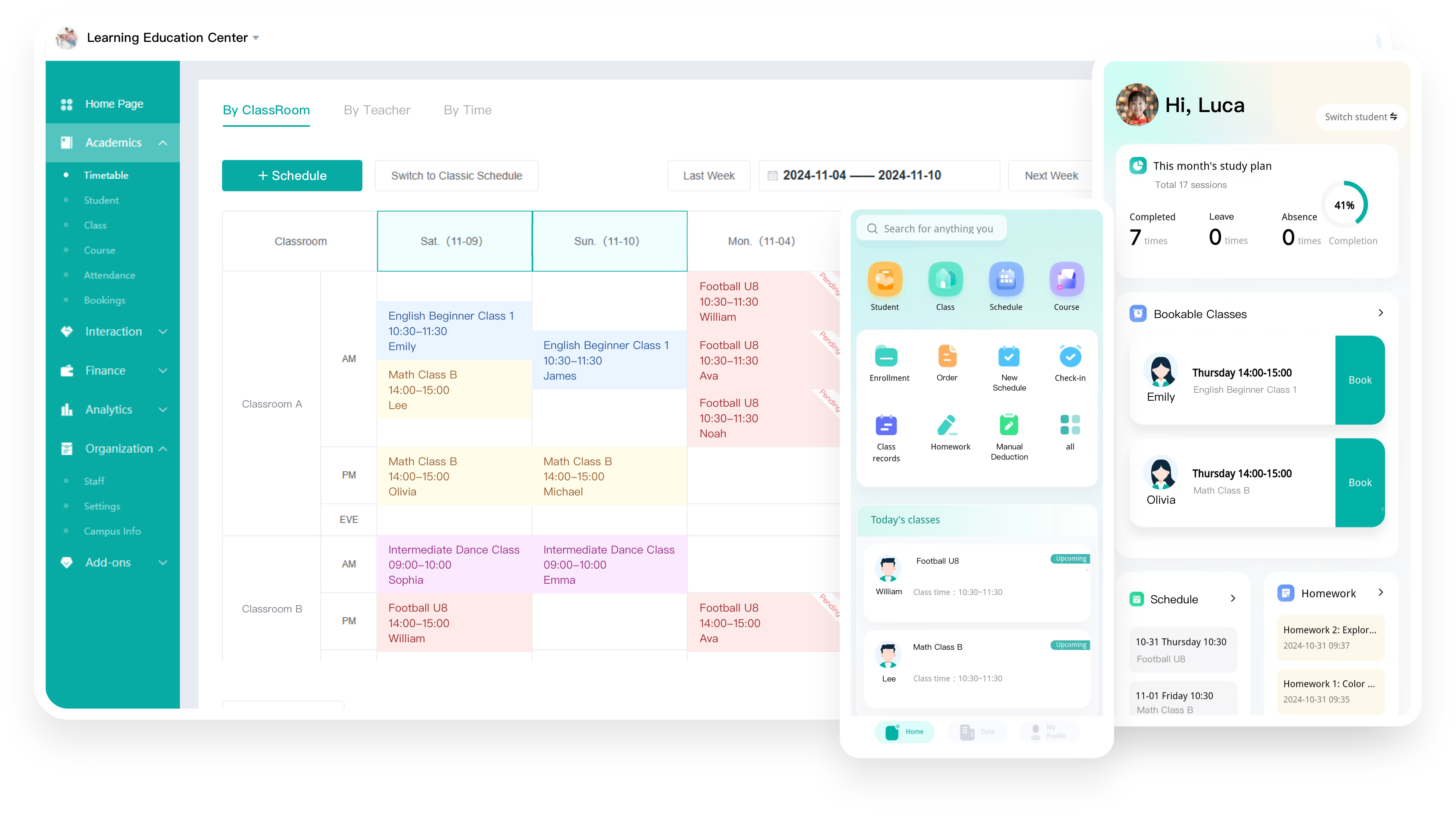
1). Growth management: Record children's growth changes and send parents their after-school changes
2). Course scheduling management: Automatically schedule courses based on resources such as teachers, classrooms, and time, reducing human intervention and ensuring the rationality of course arrangements.
3). Teaching management: Supervise teachers' teaching plans and teaching quality to ensure teaching quality.
4). Student Management: Manage students' basic information, understand their needs, and provide personalized services for them.
5). Financial Management: Integrate with modules such as enrollment, scheduling, and student management to achieve automated management of financial data.
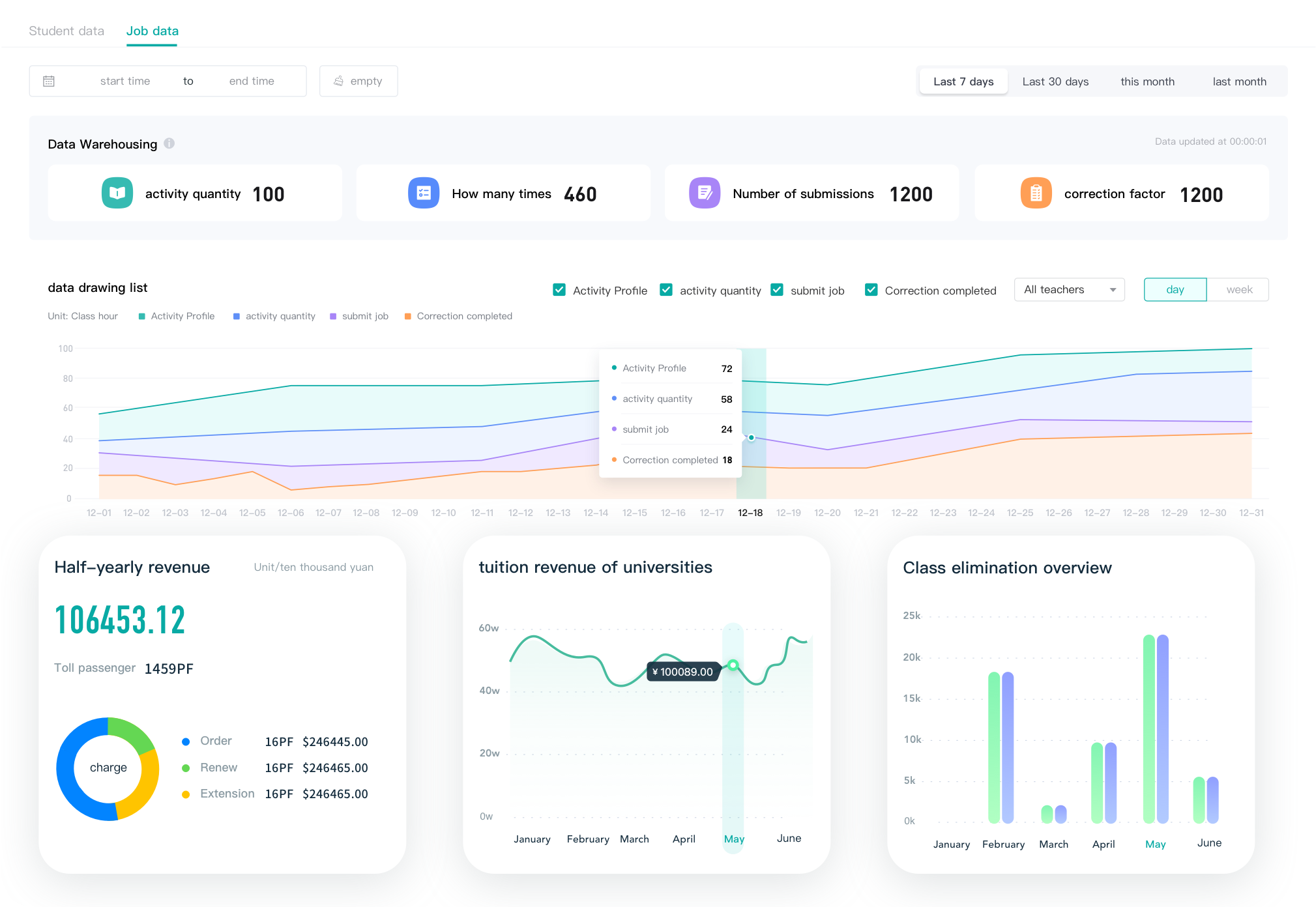
The advantage of the academic management system lies in its simplification of the traditional manual management mode, which improves management efficiency and quality.
Through powerful data processing capabilities, the educational management system can quickly process a large amount of student information, course information, financial information, and other data, greatly reducing management costs.
At present, there are many educational management system brands on the market, each with its unique characteristics and advantages, and institutions can choose according to their own needs.
2. How to choose a suitable academic management system?
Choosing a suitable educational management system should not only consider whether its functions are complete and its operation is simple, but also consider factors such as whether its services are of high quality and the price is reasonable. Below we will introduce some selection techniques:
1). Clarify needs and goals: Before choosing an educational management system, educational and training institutions need to clarify their own needs and goals. For example, what functional modules do institutions need, how many classrooms do they need, how many classes do they need, etc. Only by clarifying one's own needs and goals can a suitable educational management system be selected in a targeted manner.
2). Consider system functions and features: When choosing an educational management system, we need to consider whether its functions are complete and whether it meets our own needs. For example, whether the academic management system supports multiple enrollment methods, whether it has strong data processing capabilities, and whether it can maximize the utilization of course resources.
3). Trial and comparison: When choosing an educational management system, it is recommended that institutions try the system and personally experience whether its functions and operating procedures meet their own needs. At the same time, it can also be compared with other brands' educational management systems to understand the differences and advantages and disadvantages between each brand.
4). Price and cost-effectiveness: When choosing an educational management system, price is also a factor that must be considered. The prices of different brands and models of educational management systems vary, and institutions need to consider their own budget and needs comprehensively to choose the most cost-effective product.
3. Misconceptions and Countermeasures in Selecting Academic Management Systems
In the process of choosing an educational management system, some institutions may fall into misunderstandings. Here are some common selection misconceptions and corresponding countermeasures:
1). Only focusing on price, neglecting quality and service: Some institutions prioritize price over product quality and service when choosing an educational management system. It is recommended that institutions not only consider price factors, but also comprehensively understand factors such as product functionality, performance, stability, and the service level of manufacturers, and choose the most suitable product after comprehensive consideration.
2). Excessive pursuit of comprehensive functionality and neglect of practical needs: Another common misconception is that institutions excessively pursue comprehensive functionality and purchase many unused functional modules, wasting funds and resources. When choosing an educational management system, it is recommended that institutions select corresponding functional modules based on their actual needs to avoid unnecessary waste.
3). Insufficient understanding of one's own needs and inability to make appropriate choices: Some institutions have insufficient understanding of their own needs and goals, resulting in the inability to make appropriate choices. It is recommended that institutions fully understand their own needs and goals before choosing an educational management system, and select products that meet their needs in a targeted manner.
summary
Choosing a suitable educational management system is crucial for improving the management efficiency and teaching quality of educational and training institutions. In the selection process, we need to clarify our own needs and goals, comprehensively understand the functions and features of the product, and also consider the manufacturer's services and support.
To avoid falling into the misconception of only valuing price or excessively pursuing comprehensive functionality, one should make appropriate choices based on their actual needs.