
The education and training institution that parents hate the most, looks like this!

Parents, when it comes to enrolling their children in school hours, the 8 most disliked training institutions, come and see if your campus has similar problems?
The first type: False advertising and excessive promises
Some training institutions often use tempting and unrealistic promotional methods to attract students.
For example, claiming gimmicks such as "guaranteed score increase", "significant improvement in grades in the short term", "inability to fully refund students", "guaranteed pass", "quick fix", etc.
These promises may seem promising, but they lack scientific basis and teaching practice support.
From the perspective of educational laws, learning is a gradual process that is influenced by various factors, and no institution can guarantee specific learning outcomes absolutely.
Some institutions claim to improve students' math scores by 30 points within a month, but the teaching content and methods are not unique. When parents are full of expectations but fail to see their children achieve the expected grades, it is inevitable to feel disappointed, and the reputation of the institution will also decline among the parent group. In severe cases, it may lead to complaints and disputes, which can damage the reputation of the school district.
(Note: Appropriate attraction promotion is possible, but it is important to grasp the degree and find a balance point)
The second type: Non transparent and arbitrary charges
Playing tricks on the issue of fees.
On the surface, the course fees are relatively affordable and easy to attract parents to sign up for, but then various hidden fees follow one after another.
Some institutions require parents to "purchase learning materials forcibly", and the prices of these materials are often higher than the normal market level, and the quality is uneven; Or launch "supplementary courses" under various pretexts, implying that if parents do not purchase them, their children's learning will not be able to proceed fully.
Some institutions also adopt a "bundled sales" strategy, forcibly linking unnecessary courses with the main course, forcing parents to pay additional fees in order for their children to learn the main course normally.
This form of charging can easily cause parents to dislike it, while also greatly reducing their favorability towards the institution.
The third: Insufficient level of teaching staff
Teaching standards are the fundamental (key!) basis for the survival of educational and training institutions, and some institutions do not attach importance to this aspect.
For example, in order to reduce operating costs, hiring teachers with insufficient teaching experience and professional qualifications.
Early childhood education teachers, although having some experience in early childhood education, lack sufficient knowledge reserves in professional oral communication teaching, such as speaking skills, speech logic, and body language application, and are unable to provide students with systematic, in-depth, and professional guidance. This leads to parents' disappointment with their teaching expectations. Specialized courses such as public speaking and eloquence should be taught by teachers who have undergone systematic broadcasting and hosting, possess solid professional skills, and rich teaching experience.
Educational institutions should not sacrifice teaching quality for temporary cost control, as high-quality teachers are the foundation for the long-term survival and development of campuses. Ignoring this point will make it difficult for campuses to sustain.
The fourth type: Disorderly campus management
Institutions are relatively chaotic in management, with unreasonable arrangements for student courses and employee management.
Give a few examples:
For example, mixing children of different age groups and learning levels into one class, the teaching content cannot take into account the actual situation of each child;
For example, conflicts in course schedules result in children and parents having to rush between different classes;
For example, teachers being late before class and procrastinating after class can affect teaching order and children's learning experience;
For example, campus employees lack professional norms, making noise during work hours, not paying attention to civilized language, eating snacks at the front desk, playing on their phones, and gossiping, presenting a relaxed and disorderly work state.
The level of management reflects the operational competence of an institution. The above management issues will increase parents' dissatisfaction and greatly reduce their impression of the institution.
The fifth type: Neglecting personalized education
Every child is a unique individual with different learning styles, rhythms, and needs.
Some educational and training institutions have failed to realize this and adopt a "one size fits all" assembly line teaching model in the teaching process.
For example, the curriculum lacks flexibility and specificity, and regardless of the child's foundation and learning ability, it is taught according to a unified standard and pace. In teaching, for children with weak foundations, the consolidation and guidance of basic knowledge have not been strengthened, and for children with surplus learning capacity, there is no provision of expandable learning content, resulting in numerous difficulties or insufficient improvement for children in the learning process.
Neglecting personalized education is actually contrary to parents' expectations for their children to grow up on a learning path that suits them. When parents see their children's difficulties in learning that cannot be effectively resolved by institutions, they will inevitably become dissatisfied and question the institutions, and consider changing training institutions.
The sixth type: Environmental and safety issues
Learning environment and safety are important factors for parents to choose training institutions.
Some training institutions have rudimentary teaching environments, with mottled walls, worn-out tables and chairs, untimely garbage cleaning, poor classroom ventilation, and odors. Some institutions still have certain safety hazards, such as insufficient fire-fighting facilities, poor evacuation routes, and aging electrical equipment.
Especially in institutions such as daycare, physical fitness, and early education, children are younger and have weaker self-protection abilities, so parents attach more importance to their safety.
Once parents discover these environmental and safety issues, their inner worry will increase, fearing that their children's learning and activities in such an environment will be harmed, thereby reducing their trust in the institution.
The seventh type: The learning effect is not significant
The main reason why parents are willing to spend time and money to send their children to training institutions is to hope to see significant improvements in their children's academic performance or overall abilities.
In reality, the teaching quality of some institutions does not meet parents' expectations (note: excluding students' own reasons). This is due to various factors such as a single teaching method, outdated teaching content, and insufficient teaching ability of teachers.
For example, in math tutoring institutions, teachers simply ask children to repeat practice questions, but fail to help them understand mathematical concepts and problem-solving strategies, resulting in children not knowing how to solve slightly different types of questions in exams despite doing a large number of questions.
After a period of learning, if a child's academic performance or achievements do not improve, parents will have doubts about the teaching strength of the campus, and the renewal probability will also decrease.
The eighth type: Poor communication
Parents urgently hope to have timely and comprehensive information on their children's learning progress, classroom performance, existing problems, and directions for improvement in institutions.
Some institutions have lagging communication with parents, and some do not pay enough attention to their feedback and suggestions. Parents who want to understand their children's learning situation have to proactively contact institutions multiple times, but often receive perfunctory and vague responses that cannot meet their concerns.
Previously, a parent complained about a teacher in our campus because their child had poor test scores in English classes for several consecutive times. The parent asked the teacher for the reasons and solutions, but the teacher simply replied, "The child still needs to work hard," without specific analysis and targeted suggestions. Parents feel that this teacher does not attach enough importance to their children and has lost confidence in the institution.
The demand of parents is "high-quality education + transparent services".
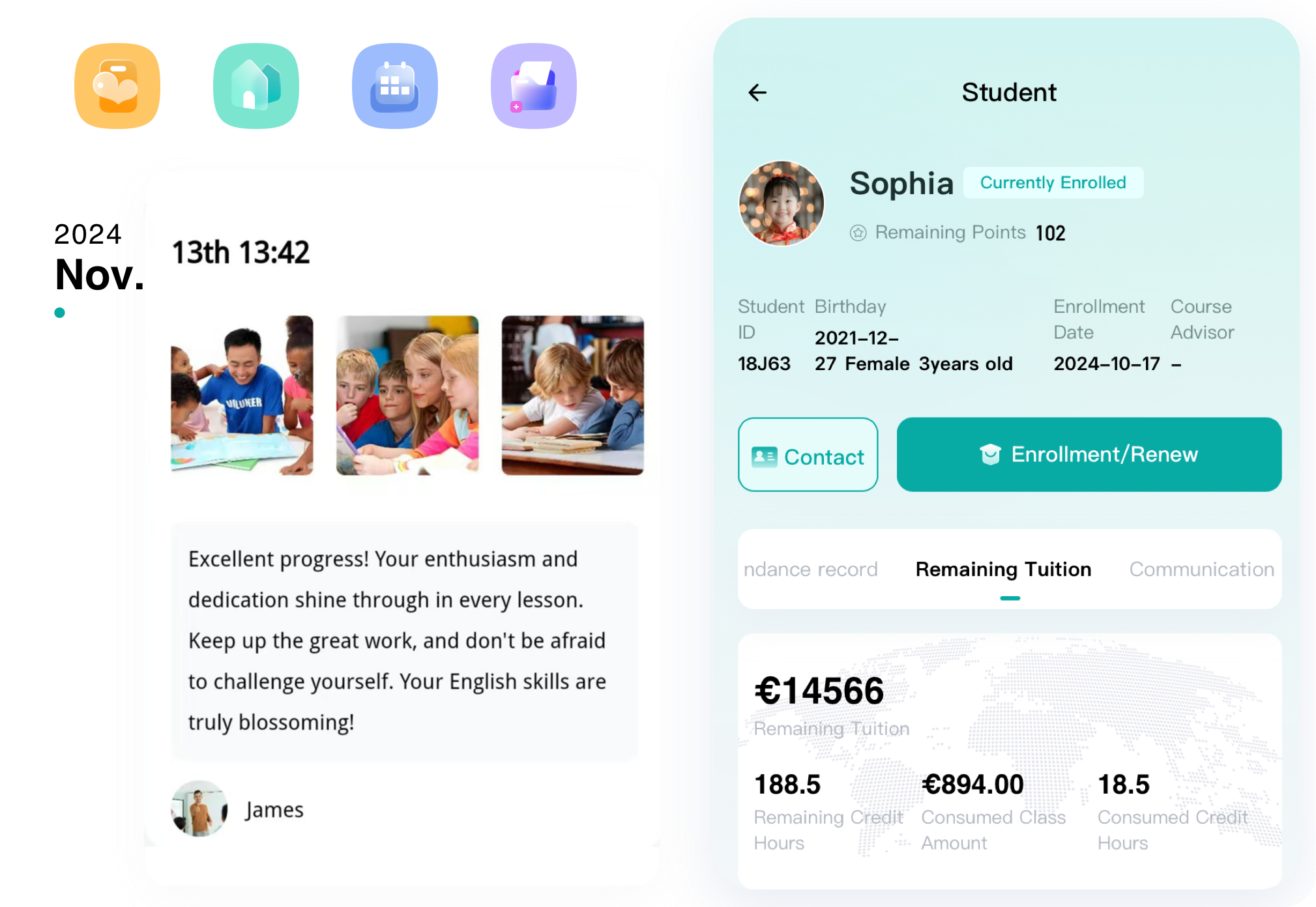
Here, we can also demonstrate this "high-quality education + transparent service" through the educational system, allowing parents to better feel the institution's dedication.
Parents value the quality of education and transparency of services the most when choosing educational and training institutions. If institutions cannot meet these basic needs, parents' resentment will intensify. Education and training institutions should pay attention to details, avoid the above-mentioned problems, effectively improve teaching quality, and provide strong support for children's growth.
In addition, the essence of our education and training business is the perfect combination of "educating people" and "pursuing profit", rather than blindly pursuing "pursuing profit" without "educating people". Only by doing a good job in "educating people" can we obtain the best and sustainable benefits.