
How training institutions can streamline their work and improve teaching efficiency

The principal of a training institution cannot simply find a few teachers, rent a venue, or recruit some students to make the institution bigger and stronger.
But principals who can truly make institutions bigger and stronger understand that the growth of educational institutions is not that simple, it requires a complete set of operational systems.
1、 First run through teaching
Most principals establish institutions, often starting from scratch alone or with one or two like-minded teachers. The key to this stage is not the scale or the recruitment of hundreds of students, but whether the "teaching output" is stable.
Teaching quality, curriculum experience, and parental feedback - these are the initial "core products" of the institution.
Just like a restaurant owner must first handle the spoon themselves to ensure a stable taste; The principal should also personally lead classes, monitor teaching, and understand the true feelings of students and parents.
Only by ensuring the smooth implementation of the curriculum system and stable teaching quality can institutions have a foundation for continued development.

2、 Establish an organization and delegate low value work
The second step is to establish an organizational structure.
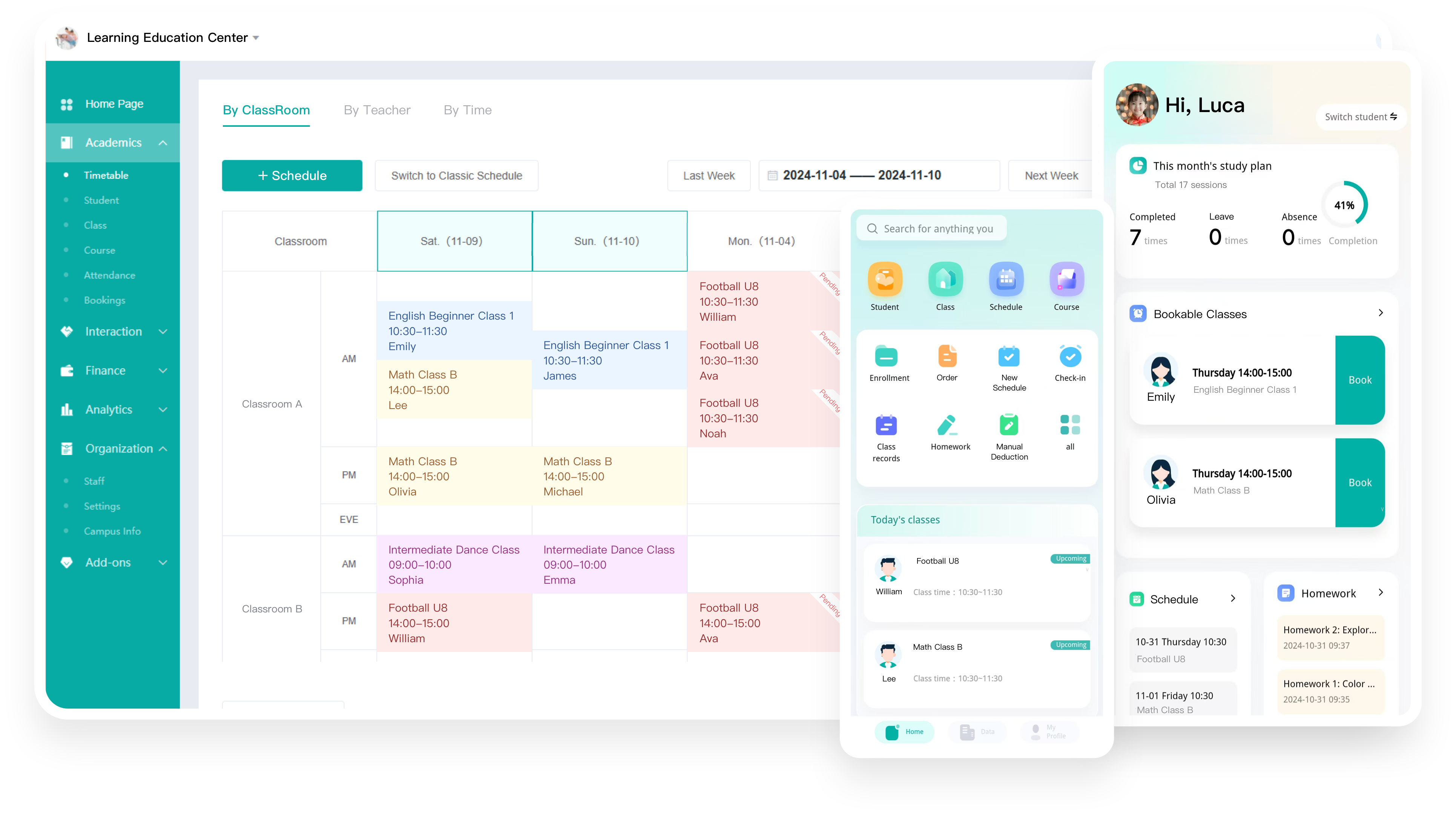
Delegate repetitive and procedural tasks, such as attendance, scheduling, class schedules, parent notifications, and registration statistics, to academic authorities or systems for completion;
Leave reception, maintenance, event preparation, and other tasks to the front desk and teaching assistants to share;
The principal should focus on core affairs such as teaching quality, team growth, parent relations, enrollment situation, and decision-making direction.
It's like the restaurant owner handing over the delivery and side dishes to the team while continuing to monitor the taste themselves.
Only with clear division of labor can institutions operate more efficiently.
3、 Establish a system between service and teaching
Teaching is the core, but service is the extension.
If the communication between parents, feedback after class, learning records, and tracking of learning progress form a closed loop, the professionalism and reputation of the institution will be doubled.
At this point, the principal needs someone to specifically "monitor services" - focusing on key indicators such as parental satisfaction, after-school communication, referrals, and renewal rates.
Once a system is formed between ensuring teaching results and ensuring service, the campus can operate stably.
4、 Focus on marketing and expand
When the teaching and service system is stable, the principal should think about "how to let more people know about us".
This is not blind advertising, but through course displays, student achievements, parental reputation, community activities, and other means, to let more people know about us, see our campus, and create real influence.
A small-scale institution relies on trust to sustain enrollment, and trust comes from visible teaching outcomes.
5、 Copy and Fission
When a campus can operate steadily without the principal personally managing every detail, it indicates that the campus's system, curriculum, services, and team have replicable capabilities.
At this point, the institution has the conditions for "fission". Multiple campus expansion, brand output, and teacher training system construction can be considered to make each campus a "self operating" unit.
The most important thing is that the development of training institutions is not supported by passion, but by a system driven approach.