






















How Training Institutions Can Build an After-Class Review System
Time:2025-10-24
Source:Artstep
Many institution directors have said this: "Actually, we aren't that different from shopping malls; at our core, we are both in the service industry." The difference is that malls sell products, while we sell courses and services. When buying products, customers check reviews; when signing up for courses, parents also look at "word-of-mouth."
During the actual student recruitment process, we've noticed a very interesting phenomenon:
- When parents come for a trial class for the first time, they often can't help but ask: "What's the feedback from other parents here?"
- Some parents, while hesitating to enroll, will ask existing parents: "What do you think of the teachers here?"
- Some parents even say directly: "I saw someone recommend you on Ins/Facebook."
What does this indicate? Reviews are a key factor influencing parents' decision-making.
From the parents' perspective, reviews provide a sense of security. Before enrolling, they need to confirm if the course is truly suitable for their child. The course details only show what the institution wants to say, while genuine feedback from other parents is the "third-party information" they trust the most.
For the institution, collecting parent feedback is the most direct channel for improvement.
Praise from one parent might help you recruit several new students; whereas dissatisfaction from one parent, if poorly handled, can likely lead to the loss of dozens or even hundreds of potential customers.
There's a classic formula in the training industry: When 1 parent is dissatisfied with the service, there are actually 25 other dissatisfied but silent parents behind them, and ultimately 500 people will be negatively affected.
Therefore, establishing a good review system allows parents to see their child's changes and progress, which in turn encourages them to provide positive feedback about the school.
Positive feedback from parents not only helps avoid misunderstandings and refunds but also directly enhances student recruitment, retention, and user loyalty. It's like a parent telling the teacher: "We've seen significant progress in our child recently. Thank you for your hard work. We will continue choosing your institution."
To get feedback from parents, you must first give feedback to students.
Why Have an After-Class Review System?
Many directors have encountered this situation:
A parent asks anxiously: "My child has been studying for so long, why hasn't their grade improved noticeably?"
The teacher patiently explains for two hours, talking about the course content, the child's areas of growth, even showing usual class notes... yet the parent remains unsatisfied and even requests a refund.
Where does the root of the problem lie? In insufficient "classroom visibility." Parents don't perceive their child's progress in daily routines and can only judge the training's effectiveness by the most direct metric – grades.
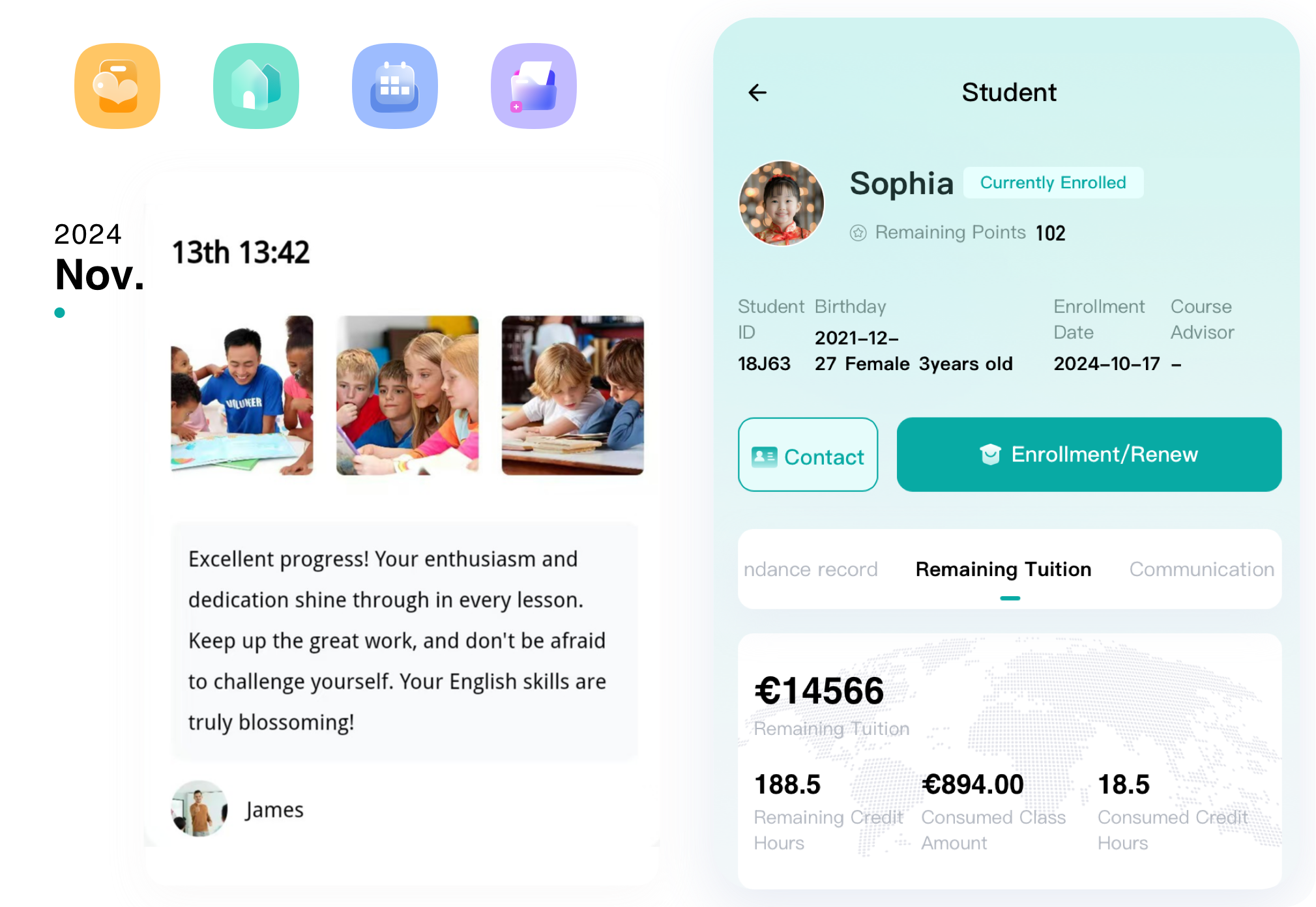
However, with an after-class review system in place, parents can see more clearly: how their child performed in class today, what knowledge they mastered, and whether they made progress. This way, the institution's dedication and value become truly visible.
How to Implement After-Class Reviews?
Teachers Proactively Review Students
An after-class review should never be just a simple "The child did well today." It should serve as a routine communication bridge between teachers and parents.
Through the educational administration system, teachers can promptly push review content to parents after each lesson, for example:
- The child's class performance today (e.g., Was they active in answering questions? Were they focused?)
- Mastery of the material (What was learned? How well was it understood?)
- Areas where parental cooperation is needed
- Include a few class photos or a short video.
These seemingly small actions can resolve many misunderstandings.
One parent once complained: "I have no idea what my child does in class." After we started pushing after-class reviews, she saw her child bravely raising their hand to answer questions in dance class, felt immediately reassured, and even praised in the group chat: "The teacher is really attentive."
For students, recognition from their teacher is the best encouragement. A child hearing "The teacher praised me!" greatly boosts their learning motivation; and they are more willing to correct shortcomings pointed out in the reviews.
Guide Parents to Review Teachers
Actually, when many parents are dissatisfied with an institution, they won't complain immediately; roughly 80% choose to remain silent. But once they can't hold it in and erupt, it often means "demanding a refund," with almost no room for recovery. We frequently encountered situations before where we didn't understand why parents suddenly became unwilling to bring their children to the institution, and often only found out the reason when we proactively asked them.
Therefore, it's even more crucial to establish a smooth communication channel before conflicts escalate. For example:
- After the teacher's review, allow parents to easily provide feedback to the teacher.
- Design a multi-dimensional evaluation system within the platform, such as "Teaching Attitude, Classroom Atmosphere, Timeliness of Communication."
- Support anonymous feedback so parents feel more comfortable expressing their true thoughts.
This way, teachers can more directly see parents' feelings, understanding what they are doing well and where they need to improve. For instance, one parent once wrote in a review: "The teacher explains things very well, but there's too much homework, the child is a bit overwhelmed." The teacher saw this, made adjustments, and the parent was quickly satisfied.
Reviews become a positive cycle: Parents are willing to speak up → Teachers improve better → Services keep getting better → Parents trust the institution more.
The after-class review system
The after-class review system is not just a "formality," but a transparent bridge between the institution and parents.
- For parents, reviews allow them to stay informed about
- For students, reviews provide encouragement and direction, enhancing learning outcomes.
- For teachers, often only found out the reason when we proactively asked them.
Therefore, it's even more crucial to establish a smooth communication channel before confl rgb(89, 89, 89);">parent feedback is the most genuine reference for improvement.
When parents are no longer anxious because they "can't see their child's changes," and teachers are no longer helpless due to "poor communication," the institution will naturally reduce refunds, increase renewals, and gain more word-of-mouth referrals.
In the end, a good after-class review system essentially tells parents one thing: We are truly dedicated to caring for your child.