
Tips for scheduling courses for training institutions

I. Production of Schedule
There are many factors that affect course scheduling by institutions, but the most important core elements are the following four:
1.Classroom, Class Time, Teacher, Class/Course
Among them, the most important is the arrangement of classrooms and time. The schedule can be presented in Excel format as follows: 1. First, create a two-dimensional form based on classrooms and time periods, with the horizontal and vertical coordinates of the classrooms and time periods.
2. Refer to the auxiliary elements beyond the core elements and fill in the fixed time period of the bound teacher's class in the specific classroom.
When scheduling classes, we need to pay attention to the following:
1. Make full use of classroom resources and improve utilization rate. Many institutions only utilize the weekend time slot, but in fact, they can also schedule classes on the evenings of the week.
2. The principle of teacher anonymity allows parents to select class hours, and the schedule does not display the specific teachers of the class, reducing the dependence of the campus on teachers and facilitating the exchange of teachers by institutions.
Of course, if your campus focuses on recruiting famous teachers, you can mark the classes of famous teachers in clear colors in the schedule, which can be used as a "limited quota" to promote enrollment.
II. Planning of Course Scheduling
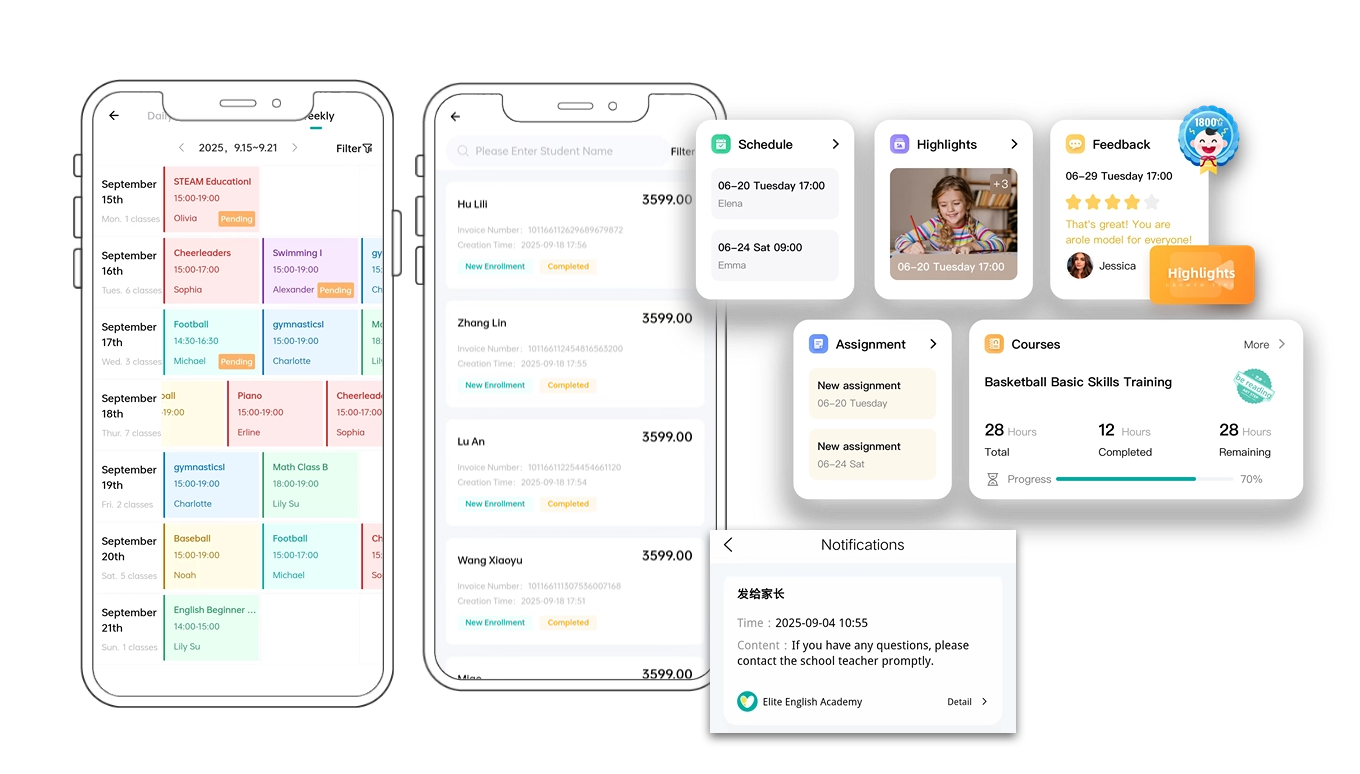
To ensure the smooth progress of various campus tasks, it is necessary to schedule classes in advance. We can plan the key points of scheduling according to the time nodes:
1. During the peak season, we need to recruit students and focus on quick conversion to attract new students. In addition to long-term classes, the key focus of course scheduling is on open classes (1 class)
2. During the off-season, we need to focus on marketing and attract traffic through various activities. In addition to long-term classes, the key focus of class scheduling is on attracting traffic (4-6 classes)
3. Among them, during winter and summer vacations, attention should be paid to adding class types, short-term classes, and special offer classes. The scheduling of class hours can be staggered.
4. During holidays, it is important to avoid scheduling classes to reduce disputes over leave requests and make-up classes.
III. Calculate the number of students that can be enrolled in the campus
1. Number of students that the campus can accommodate
Taking the campus as an example with one class per week, a full class of 12 students, 6 classrooms, and 1.5 hours per class (including ten minutes after class):
Step 1: First calculate the number of students that can be accommodated in a classroom. 1. Monday to Friday: 6 time periods (5+1) 6 classes. 2. Saturday to Sunday: 12 time periods (6 * 2) 12 classes. The number of students that can be accommodated in a classroom: 18 classes * 12 people=216 (people)
Step 2: Calculate the number of students that the campus can accommodate. 1. If there is one class per week: 216 people * 6 classrooms=1296 (people). 2. If there are two classes per week: 216/2 * 6 classrooms=648 (people). 3. If there is a one-on-one class per week, 18 people * 6 classrooms=108 (people)
2. Number of students required to enroll in the campus
Step 1: Count the number of students who need to continue classes in each existing class. Subtracting the number of students who need to continue classes from the number of students who are full is the number of students who need to be added to the existing class
Step 2: Count the available classrooms and teacher class time periods, calculate the number of new classes that can be opened, and multiply the number of available classes by the number of full classes to obtain the number of new classes
Step 3: Add up the two data above to obtain the total number of students that the campus needs to enroll at this stage.
3. Calculate the campus/teacher class balance and timely merge classes
The low class occupancy rate may have a direct impact on the campus:
Teacher resources are greatly wasted, and the saturation rate of teacher resources is very low. Teacher salaries are high, course consumption is low, and contribution is low
Therefore, we need to pay attention to the class occupancy rate of the campus in a timely manner, pay attention to the number of students in each class, and do a good job in merging classes in a timely manner. Attention should be paid to combining classes: with the same teaching progress, the same teacher/teacher's style is similar. This way, it will be easier and have a higher success rate for the joint class work of students' parents.
IV. Other precautions for scheduling courses
1. For different age groups and subjects, scheduling should follow the lifestyle and study habits of the main user groups.
2. Schedule of trial classes
If it is a trial class within the week, it can be arranged during the first class period, which can leave enough time for the consulting teacher to consult with parents after the trial class ends; If it is a weekend trial class, it can be arranged in the middle of the morning or afternoon, which is the peak time for the campus traffic. This can allow parents to actually experience the scene of the campus and stimulate a herd mentality.
3. After the start of the class, the class arrangement for new students
If the number of people is small, the first consideration must be to transfer to another class.
If there are a large number of students and new classes need to be opened, priority should be given to using teachers with similar teaching progress to open parallel classes with similar class times. This way, subsequent courses can consider combining classes, releasing new classrooms and time slots, and then opening the next class.
Of course, mastering the above skills is far from enough for institutions to provide manpower and efficiency through course scheduling, and to maximize the allocation of campus resources. It is also necessary to master the principles and underlying logic of course scheduling.