
Teaching, training, and sales are all masters of casual conversation!

I have seen many education and training salespeople, and I always feel that "signing orders" relies on "hard talk" - throwing out course highlights, asking for demand, quoting price lists, and smashing rhetoric like a machine gun.
But true sales often come in reverse.
They are not in a hurry to talk about courses, but rather enjoy "chatting": talking about cartoon stickers on their children's backpacks, camping photos on parents' social media, and the milk tea shop that always queues at the school gate. Do you think this is a waste of time? In fact, the transaction password of the education and training industry is hidden in these seemingly unrelated chats.
The essence of idle talk is to 'tear down walls'
When parents bring their children for consultation, there is a wall in their hearts: 'He definitely wants to promote' and 'Don't be fooled by tricks'. Hard talking about courses will only make this wall higher and higher.
But the idle chatter about selling the crown is tearing down the wall.
Last time at the campus, I saw a new parent who had just entered the school and stared at the robot model on the display shelf. She didn't say 'we have robot classes', instead she squatted down and asked the child,' This robot can dance. Do you like building blocks at home? When my nephew is building blocks, he always says he wants to give the robot wings. What kind of wings do you think look good? 'Three minutes later, the child held her hand and said,' Auntie, I want to try it. 'The parents' guard also relaxed - when you stand on the same channel as the child, the parents naturally think,' This person understands the child, not just staring at my wallet. '.
People who can chat know how to "trade their ears for needs".
The easiest pitfall for education and training sales is' I think you need it '. But the real needs are never guessed, they are talked about. A salesperson once shared her secret: ask less about "what class do you want to enroll in" and more about "what is the most troublesome thing for you when accompanying your child to do homework?" A mother said, "When your child writes an essay, you always make up the word count." She didn't answer, "We have an essay class," but instead said, "My child is the same. Later, I took him to the park to pick up fallen leaves and asked him to make up stories about them. Now he can't stop writing - have you ever tried to observe life with your child?" The mother's eyes lit up: "I haven't really tried it! Do you teach like this in class?" You see, demand is not sold out, it is actively spoken out by the other party after being "talked to the heart. The.
Top level casual conversation is the skill of 'remembering details'
I have seen the most powerful sales champion, and in my phone memo, I remember the parents' "random thoughts": "Lily caught a cold last week and likes to drink pear soup" "Tom is addicted to Ultraman and wants a Sailor figurine the most" "Wang mentioned that her grandson is weak in math but likes to play poker". Next time the parents come, she casually mentions, "I heard my child's cold has cured? My mom has been adding Sichuan scallops to pear soup recently, and she said the effect is particularly good". The parents instantly feel that "she actually remembers what I said".
Education and training sales not only sell courses, but also the feeling of being valued.
The details recorded during casual conversations are the key to making parents feel that 'you understand my child'. In fact, there is no such thing as a "natural sales champion" in the education and training industry.
However, some people have turned "hard selling" into "soft connections", "speaking lines" into "chatting about life", and "selling courses" into "being friends".
After all, no parents are willing to pay for cold language, but everyone is willing to pay for the sincerity of 'understanding their children and understanding themselves'. Next time you see your parents, don't rush to look for the class schedule. First, ask the child what they played yesterday and talk about the parents' recent troubles - maybe the opportunity to sign the bill is hidden in this unfinished cup of milk tea, hidden in the phrase 'My child is like this too'.
Why do some parents of training institutions refuse to renew their subscription
Teacher, have you ever encountered such a situation?
The child is clearly doing well, but the parents are still unwilling to renew the subscription; Parents are still hesitant to make phone calls, send messages, or offer discounts.
In fact, renewal is never persuaded, but rather perceived by parents themselves.
The core of perception is to show parents how much they value their children.
The following three "visible values" are more effective than 100 sales sentences, and we suggest everyone refer to and learn from them.
Attention to details
Remembering a child's' little things' is the greatest effort. The principal of a fan organization (art institution) on the platform has a renewal rate of up to 85%. What is her secret? She requires every teacher to remember three "little things" about each child: their favorite color, their favorite painting technique, and their most proud work. each
When the second parent comes to pick up their child, the teacher will naturally tell them, 'Today Mia drew a particularly creative sky in her favorite sky blue color, and she said she wants to give it to her mother as a birthday gift.'. ”How do parents feel when they hear this sentence? My child here is not a number on the assembly line, but an individual who is truly seen and remembered.
This kind of attention to detail is more touching than any course introduction.
The Importance of Growth
Visualize progress and make changes perceptible. Many institutions are saying 'we focus on children's growth', but how does growth manifest? We can't just talk about it.
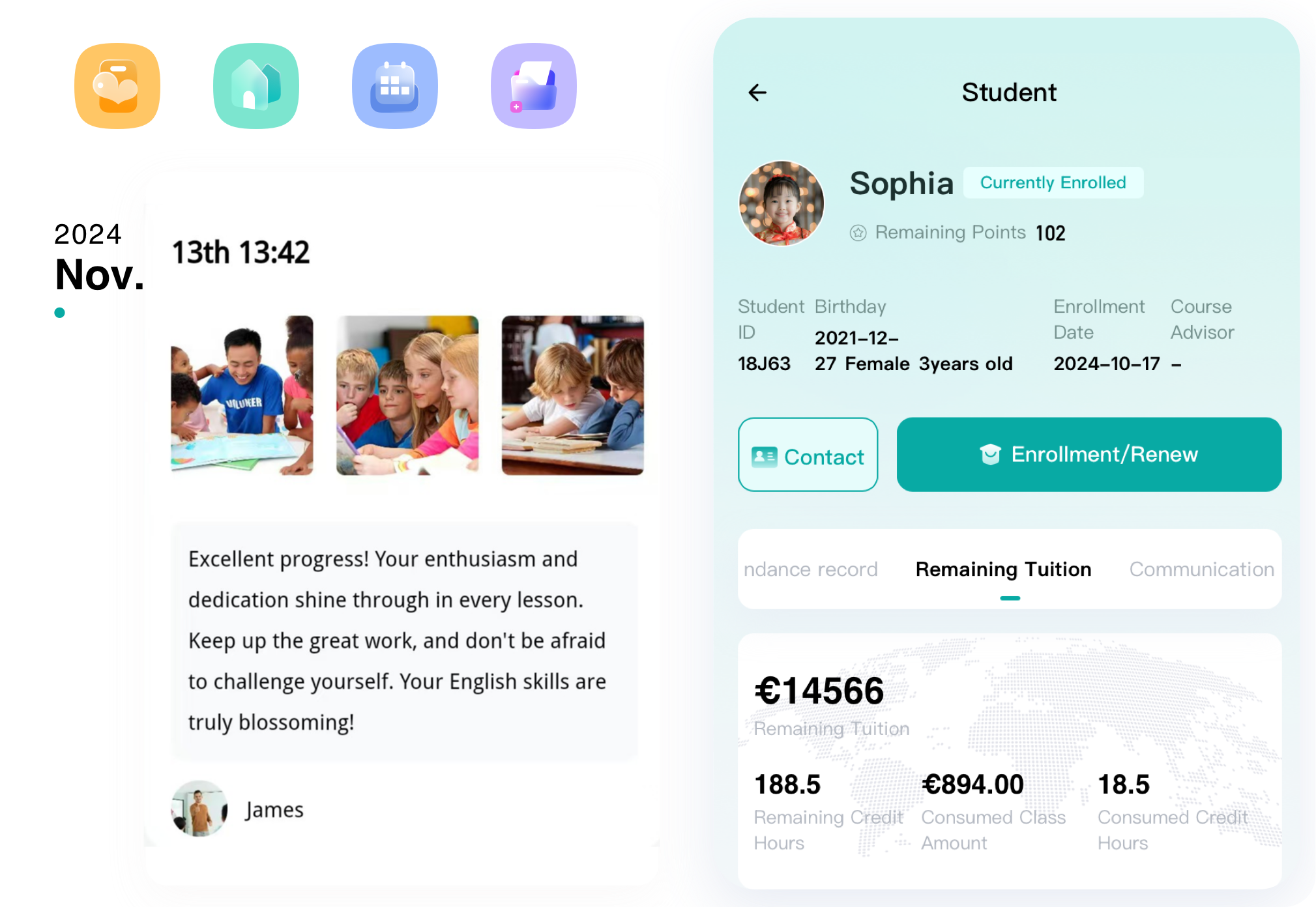
Smart institutions will do three things: systematize learning records: record every class, every work, and every progress; Visual comparison of growth: comparison of works from three months ago and now, and comparison of spoken language when I first arrived and now; Personalized feedback concretization: Instead of saying 'the child is great', it means' the child's imagination is particularly rich, and today there has been a breakthrough in composition '.
Parents who see these tangible changes will naturally increase their satisfaction and willingness to renew.
Importance of Communication
Regular 'exclusive reports' instead of' mass notifications'. A question for educators: How do you communicate with parents about your child's learning situation? Most institutions provide learning feedback at the end of the month or only contact parents if there are any issues. This method is outdated. The practice of high renewal rate institutions is to have personalized communication once a week and exclusive growth reports once a month.
The key is that this communication is not template based, but targeted at each child: "Mia's mother, this week Mia has made a particularly big breakthrough in mathematical thinking. He actually came up with three problem-solving methods on his own. This is the specific problem-solving process, you can take a look ..”
Mia Dad, Xiao Yao's concentration has significantly improved recently, from being able to sit for only 15 minutes to now being able to focus for 30 minutes. These are some details we have observed ..”
Parents who receive such communication will feel that you are always paying attention to their children, rather than leaving them unattended after paying the money.
Many educators say: I know these methods, but they are too difficult to implement. Indeed, it is easy to do it occasionally, but difficult to form a system and culture.
Here are three implementation plans for you:
1. Establish a campus culture of 'every child is important'
From principal to teacher, one must firmly believe that there are no ordinary children, only undiscovered characteristics. Regularly hold "Discovering Children's Highlights" sharing sessions to help teachers develop the habit of observation and recording.
2. Design a 'visible care' service process
Incorporate the emphasis on children into every service aspect: from the first personalized greeting upon entering, to targeted encouragement in class, and then to one-on-one feedback after class, forming a complete care loop.
3. Liberate manpower with tools and ensure execution with systems
Make good use of information technology tools and establish a growth record system for each child. Teachers only need to spend very little time recording, and the system can automatically generate growth reports and learning trajectories, making care more efficient and systematic. What we do in education is essentially a trust entrustment.
Parents entrust their children to us, not with money, but with expectations and hopes. When we truly care about every child and make them visible and valued, renewal is no longer a problem, but a natural outcome.
Remember: Parents have bright eyes, and they can feel every little effort you put into their children. And this feeling is the most solid foundation for renewal.